Eumen Hoxa
The Reincarnationist PapersEumen Hoxa is a Bulgarian captain remembered both as a decorated battlefield legend and as a commander willing to force his men into a perilous attack. In Vasili Arda’s account of the Cherna River battle, Hoxa’s boldness becomes the organizing force of a night when five howitzers, a storm, and the rising river leave his company with almost no margin for retreat.
Identity and Reputation
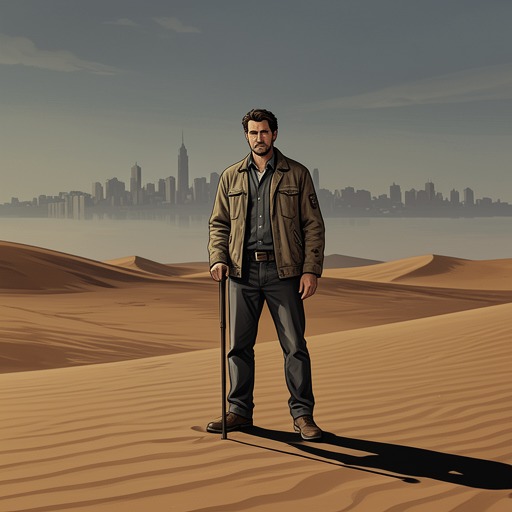
Vasili Arda identifies Hoxa as his commanding officer in the autumn of 1918, during the single battle in which Arda says he took part. Hoxa’s military reputation, however, reaches well beyond that brief encounter. He had won Bulgaria’s Order of Bravery, First Class, its highest military combat honor, in the first week of the war. The account associates that distinction with an earlier exploit against a retreating Romanian column near Petrila: acting without authorization, Hoxa led his company in a flanking maneuver, moving seventy men and ten artillery pieces thirty miles in a day and a night. At first light, his company attacked and captured four generals of the Romanian High Command.
The episode establishes the combination that defines Hoxa in the later battle: tactical daring, initiative beyond his authority, and a record that makes his subordinates wary of what he might attempt. His courage did not lead to promotion beyond captain. The account links his stalled advancement to his detestation of rear-area commanders, while describing his assignment to the front as the reward for his bravery and initiative. Hoxa is thus presented as both a celebrated officer and a disruptive one, valued for action yet poorly suited to the hierarchy behind the lines.
Command on the Cherna River
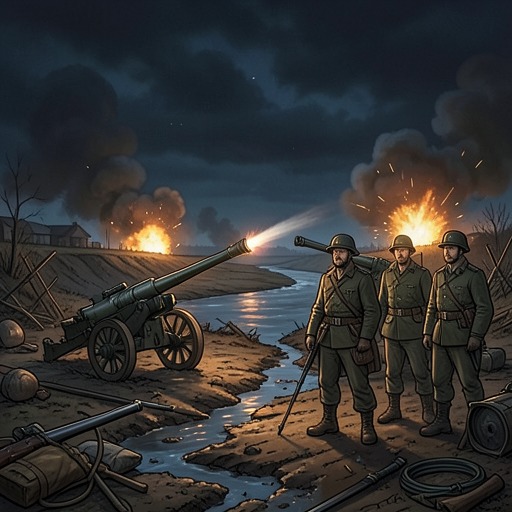
The battle takes place on September 18 and 19, 1918, after the Bulgarian front has been retreating for three weeks. Hoxa’s company occupies a small triangle of land where the Cherna River flows into the Vardar River, a position Arda regards as an unpromising place to make a stand even for one night. The company’s five Krupp 77-millimeter howitzers face south, toward Greece and two French divisions somewhere beyond the horizon. Arda and the other artillerymen stack seventy-five-pound shells beside the guns, hauling them from a horse-drawn wagon and preparing the emplacement.
Hoxa appears among this work with an exacting, hands-on command style. He tells Arda to bring every round out of the wagon, then sends him to help another squad. When the men complain about repeatedly moving shells and about the exposed position, Hoxa suggests that they may get their chance to fire that night. He orders all five crews to prepare their positions and camps within an hour, tie the horses by the river, and keep the fires to a minimum. His warning that two full-strength French divisions are sleeping in the valley makes the danger plain, even before he reveals his plan.
The Storm and the Attack
After visiting the other artillery companies, Hoxa returns excited and announces that they are ready for what he calls the reckoning. He plans to attack by surprise when the rain begins, striking the French while they sleep in their tents. When a corporal objects, Hoxa draws his revolver and points it at the man’s nose, making clear that disagreement will not stop the order. He assigns high-explosive rounds to the other crews but tells Arda’s second squad to prepare five white-phosphorus rounds. The other companies cannot see the French bivouac, he explains, but they will be able to see the phosphorus shells bursting and use those flashes to direct their own fire.
Hoxa waits astride the raised barrel of the third gun as lightning, thunder, and rain gather over the valley. The storm reaches the French camp, as he had hoped. He then orders the second squad to raise its gun to twenty-three degrees and fire. The first phosphorus shell travels two miles before bursting, its burning fragments fanning through the night and marking the target for the other companies. Hoxa’s plan depends on coordination as much as surprise: he has arranged for the flashes to guide the guns that cannot see the enemy position directly.
When Hoxa detects the French advance, he jumps from the wet gun into the mud beside a fallen trigger man. He gets up and runs past the remaining trigger men, striking each with his riding crop as he urges them to hold fire until given fresh orders. He then directs the crews to raise their guns to forty degrees and load phosphorus. As the French come closer, the other companies redirect their fire toward the bursts. Hoxa stands on a mound between the second and third guns, watching through binoculars and conducting the bombardment with his crop as if directing an ensemble.
Risk, Control, and the Account’s Limits
The attack’s geometry tightens around Hoxa and his men. The Cherna River rises, removing the possibility of retreat, while the approaching infantry forces the gun crews to raise their barrels and bring each new burst closer to their own position. The guns eventually reach their maximum elevation. Their shells arc high but land only three hundred yards away, and Hoxa looks up at the raised muzzles in frustration that they cannot be pointed higher. His assault has transformed the weather and the artillery into weapons, but neither his audacity nor his control can overcome the guns’ physical limit.
Hoxa’s portrayal rests on a sharp contrast: the officer who once maneuvered freely against a retreating column is now directing an improvised night attack from a precarious position, with the river behind him and French infantry closing in. His threats, close supervision, and spectacular use of phosphorus show command exercised through force and personal nerve; the carefully timed signals show that his boldness is also calculated. The surviving account follows his decisions through the guns’ maximum elevation, while Arda identifies the engagement as his only battle and says that he and his men survived. It presents Hoxa as the decisive commander of that encounter, without resolving here what became of him afterward.